
Anybody can put an edge on a blade. Putting the right edge on it, at the right angle, without cooking the steel, and balanced so it doesn't chew up your spindle, is what separates a crew that gets a clean cut and long blade life from one that's buying blades twice as often as it should.
If your blades are getting "worn out" fast, there's a decent chance they're not worn out. They're sharpened wrong. Here's how to do it right.
How sharp should a mower blade be?
Sharp like a butter knife, not a razor. A mower blade cuts by impact and airflow, not by slicing. Take it too thin chasing a razor edge and it dulls faster and chips. You want a clean, consistent edge along the whole cutting length, at the factory angle, with no dents or curl.
What angle do you sharpen a mower blade at?
Match the factory bevel, which on most commercial blades runs 30 to 35 degrees (some heavy-duty blades are closer to 45). Don't reshape it to something steeper or flatter. The manufacturer set that angle for a reason, and a consistent factory-angle edge holds up better than a sharper one that folds over. The single most common sharpening mistake is changing the angle every time the blade gets touched up.
The mistake that actually kills blades: overheating
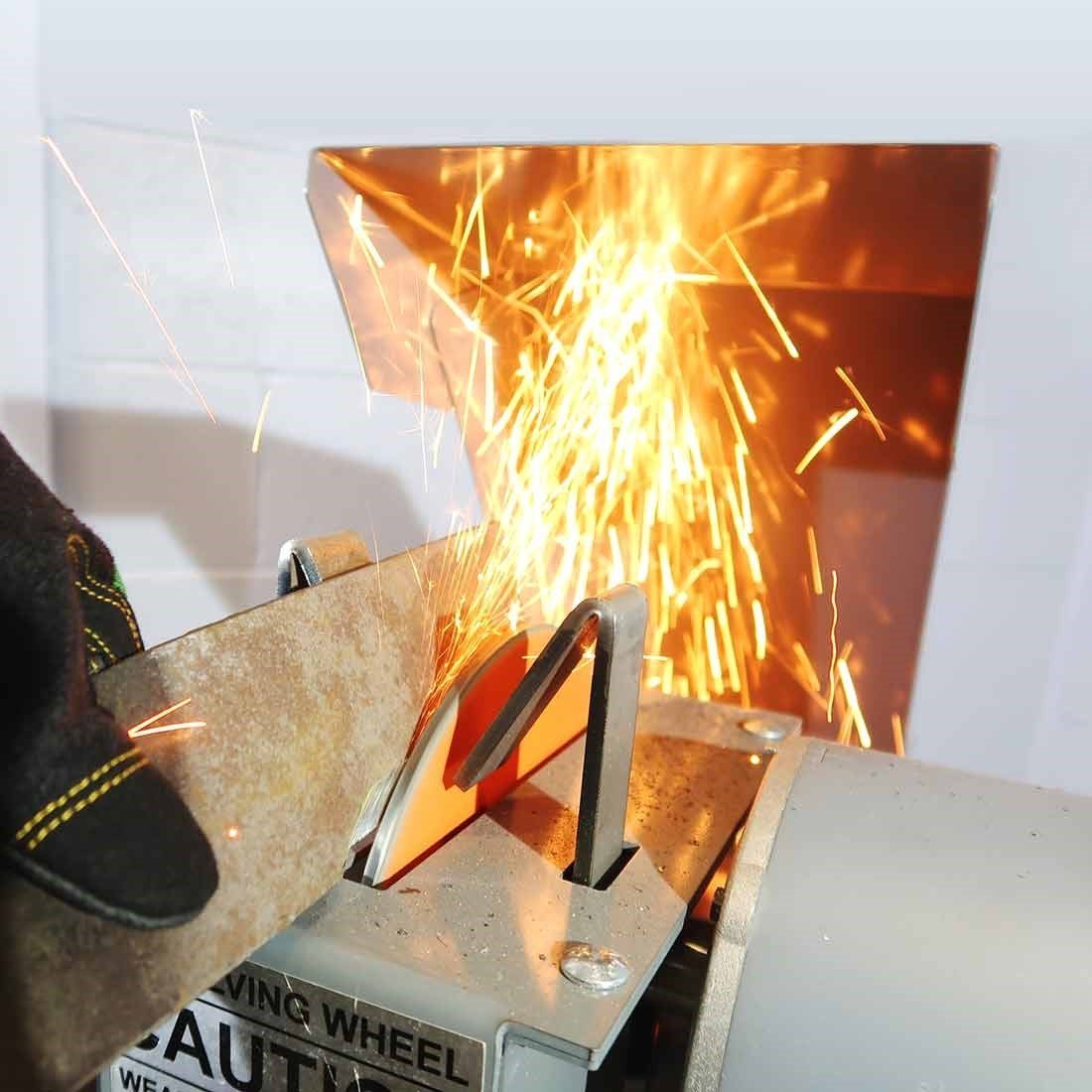
Grind too hard or too long and the steel heats up and turns blue. That blue color means you've pulled the temper out of the metal. A detempered edge goes soft and dulls almost immediately, and no amount of resharpening brings it back. This is the fastest way to ruin a good blade, and it's exactly what happens when you lean on a high-speed bench or angle grinder with no feel for heat. Keep the pressure light, keep the blade moving, and keep a bucket of water nearby to cool it.
Balance the blade after every sharpening
Sharpening removes metal, and it rarely comes off both ends evenly. An unbalanced blade spinning at 3,000+ rpm shakes the whole deck. That vibration wears out spindle bearings, loosens hardware, and gives you a rougher cut. Check balance with a simple cone or nail balancer after every sharpening and grind a little off the heavy end until it sits level. A five-dollar balancer saves you a spindle.
Bench grinder, angle grinder, or a dedicated blade grinder?
A bench or angle grinder works if you've got the feel to hold the angle and not blue the steel. The problem is consistency across a stack of blades and across whoever on your crew is doing it. A dedicated blade grinder holds the angle for you and takes the heat guesswork out, so every blade comes off the same and the temper stays in.
For a crew sharpening a fleet's worth of blades every week, that consistency is the whole game. An RBG grinder brings sharpening in-house, ends the recurring cost of paying a shop, and for a mid-size operation pays for itself in a single season. More on that trade-off, and how the RBG holds up against cheap import look-alikes, in this breakdown.
New to sharpening, or bringing a crew member up to speed? Start with our step-by-step sharpening guide.
Tools you need to sharpen commercial blades
You do not need a full shop to sharpen well, but the right setup makes it fast and repeatable across a fleet.
- A dedicated blade grinder for volume. If you are sharpening every day, a purpose-built grinder holds a consistent angle and gets through a fleet far faster than freehand tools.
- Gloves and eye protection. Non-negotiable around a spinning wheel and hot metal.
- A blade balancer. Cheap, and the only way to confirm the blade is even after grinding.
- A vise or blade clamp to hold the blade steady if you are not using a dedicated grinder.
- A wire brush and rag to clean caked grass and dirt off the blade before you grind.
How to sharpen a mower blade, step by step
- Pull the blade safely. Disconnect the spark plug, tip the mower with the air filter and carb up, and mark the bottom face so it goes back on the same way.
- Clean it. Wire-brush off the packed grass and dirt so you can see the actual edge.
- Grind to the factory angle. Follow the existing bevel, usually around 30 to 35 degrees. Keep the blade cool and take light passes.
- Keep both sides even. Take the same number of passes on each end so you remove the same amount of steel and keep the blade balanced.
- Balance it. Hang it on a balancer. If one side drops, grind a little more off the heavy end until it sits level.
- Reinstall correctly. Bolt it back on with the marked face down and torque to spec.
Getting more life out of every blade
- Sharpen on a schedule, not on a hunch. Commercial crews run roughly 8 to 10 mowing hours between sharpenings. Build it into the routine so no blade runs dull for days.
- Do not overheat the steel. A blade ground blue has lost its temper and will dull fast. Light passes, cool it often.
- Rotate blades across machines so wear stays even across the fleet.
- Avoid the curbs and rocks you can. Most deep damage is one hard strike, not normal wear.
Sharpening brings an edge back, but every blade eventually gives all it has. For the five signs a blade is past sharpening and needs replacing, see our complete guide to lawn mower blades.
The payoff
A correctly sharpened, balanced blade cuts cleaner, runs smoother, and lasts longer. It also uses less fuel: sharp blades use up to 22% less fuel per acre than dull ones (University of Nebraska, Steinegger et al., 1983). Across a fleet running all day, that adds up.